
Understanding Alpine Light
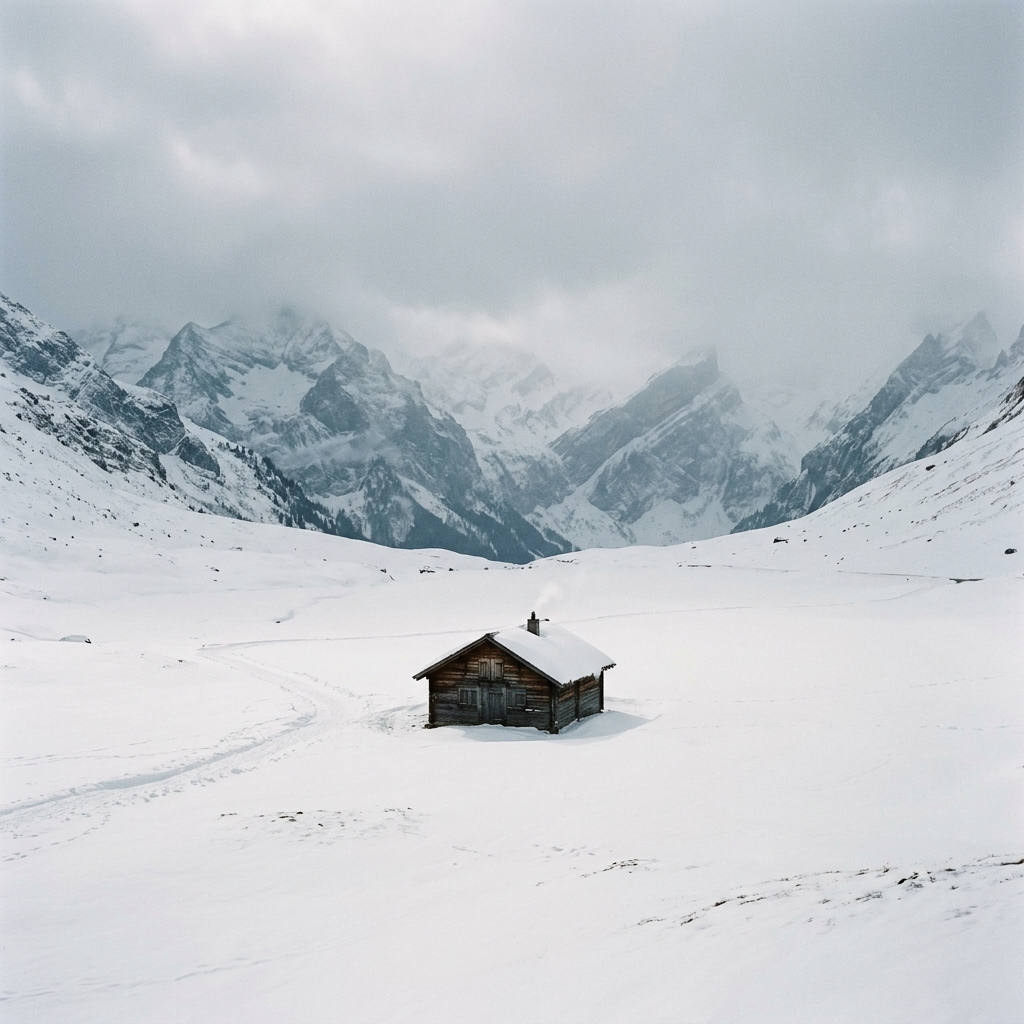
Shooting in the Swiss Alps during winter is a process of physical endurance and visual distillation. At high altitudes, the air is thin, and the light behaves differently. The blue scatter of the atmosphere is reduced, resulting in incredibly crisp, high-contrast shadows. However, this sharpness can often feel clinical or sterile on digital sensors.
To capture the emotional weight of these cold spaces, I continue to rely on medium-format film, specifically Fujifilm Velvia 50 for color work and Ilford Delta 100 for black and white.
The Character of Winter Light
During a winter storm, the clouds often sink low into the valleys, wrapping around mountain shoulders like heavy blankets. If you are fortunate enough to stand at the edge of this weather system, the light is completely diffused. There are no direct shadows, and the mountains appear as soft charcoal washes on paper.
This is the condition under which Alpine Silence was made. By centering a small wooden barn in the middle of a massive snow field, the composition emphasizes the vastness of the environment. The cabin ceases to be a human utility and becomes a marker of scale, highlighting the quiet grandeur of the Alpine valley.
Technical Challenges of Alpine Work
Working in sub-zero temperatures presents several technical challenges for photographic equipment:
- Mechanical Shutters: Electronic cameras suffer from rapid battery drain. I use mechanical cameras like the Hasselblad 503CW, which operates fully mechanically without batteries.
- Exposure Metering: Snow fools camera meters into underexposure, turning white snow into mid-grey. Exposure must be carefully metered using a spot meter, manually placing the brightest snow values in Zone VII or VIII of the Zone System.
- Film Brittleness: In extreme cold, film becomes brittle and can easily snap when winding. The film must be advanced slowly and with steady pressure.
The deliberate pace imposed by these constraints is not a hindrance—it is the core of the creative process. It forces the photographer to wait, to observe the slow shift of shadow and light, and to expose only when the alignment of elements is perfect.